China’s Industrial Profits Are Slowing: Is Beijing’s Growth Model Hitting a Wall?
(7 minute read)
- China’s industrial profit growth has slowed for three straight months, hitting its weakest pace of 2026 in July; even as the economy still posted double-digit gains.
- The slowdown is not a blip. It is the visible edge of a structural problem: an economy built on exports and manufacturing, propping up growth while household spending stays flat.
- Understanding why Beijing keeps choosing restraint over a big stimulus push is the key to understanding what happens next; for China, and for every economy that trades with it.

By William Willis and Michael Manners
China’s National Bureau of Statistics released a number in late August that looked, on the surface, unremarkable: industrial profits rose 11.2% year-on-year in July.
In most economies, double digit profit growth would be a headline in its own right. In China, it was reported as a slowdown; because it was. July’s figure was down from 15.1% in June, which was itself down from 21.1% in May and 24.7% in April. Three straight months of deceleration, landing on the weakest monthly pace of the year.
Zoom out further and the pattern holds. For the first seven months of 2026, industrial profits are up 17.6%; a healthy number, but below the 18.1% economists had forecast, and part of a steady march downward from the near 25% growth China’s industrial sector was posting back in April. Second quarter GDP growth came in at 4.3%, the slowest pace since late 2022.
None of this means China’s economy is collapsing. It means the easy part of the recovery is over, and what’s left exposes something Beijing has been reluctant to confront directly: a growth model that increasingly depends on selling to the rest of the world, because it cannot get its own households to spend.
What’s Actually Driving the Slowdown
The headline profit numbers this year were flattered by two temporary tailwinds: an AI driven boom in chip and equipment manufacturing, and a run up in commodity prices tied to the Middle East conflict, which briefly padded margins across industrial firms. As oil prices have eased back and that price effect has faded, the underlying weakness in domestic demand has become harder to disguise.
That weakness is stark. Retail sales grew just 0.7% in the first half of 2026; compared with over 4% in the United States over the same period. Total social financing, China’s broadest measure of credit flowing into the economy, has been setting fresh all time lows for three consecutive months, meaning fewer households and businesses are borrowing to spend or invest.
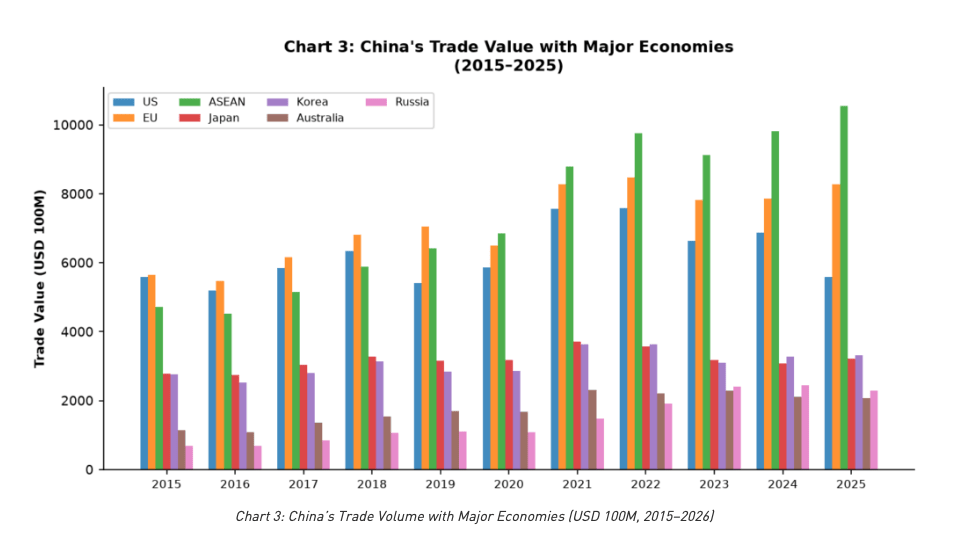
Auto manufacturing, often a marker for consumer confidence, saw profits fall 19.5% in the first half of the year, as car sales dropped for a ninth straight month. What’s kept the headline numbers afloat instead is exports. China posted a record trade surplus of close to US$1.2 trillion in 2025; and export strength, not domestic consumption, has been doing most of the work to keep growth near Beijing’s 4.5–5% target.
With ASEAN overtaking the US as China’s largest trading partner, and direct exports to the US dropping from around US$525 billion in 2024 to US$420 billion in 2025. China has spent years deliberately diversifying away from American demand: the US share of China’s total trade has fallen from roughly 14.2% in 2017 to about 10.8% by 2024.
Yet, this is a fragile foundation. It has shifted where it sits. Export led growth is hostage to trade policy somewhere, and diversification just spreads that exposure across more borders rather than eliminating it.
The US has already started threatening tariffs on the transshipment hubs China has been routing goods through, and EU officials have begun raising anti-dumping concerns as more of that redirected volume lands in Europe. The specific customer has changed. The reliance on someone, somewhere, continuing to absorb what China’s factories produce has not.
Has the Stimulus Playbook Run Out of Road?

Faced with a similar slowdown a decade ago, Beijing’s instinct would have been to lean harder on the tools that have worked before: infrastructure spending, credit expansion, support for property and manufacturing investment.
Some of that is still happening; 2026 fiscal policy has been described officially as “proactive,” and monetary policy as “moderately loose,” with room for further rate cuts. But the scale has been notably restrained. At the Two Sessions earlier this year, leadership again avoided announcing large scale demand side stimulus, sticking instead to a strategy of hitting growth targets through industrial output rather than a genuine consumption boost.
That restraint is deliberate, not accidental. Economists such as Peking University’s Huang Yiping have described China’s core problem as “strong supply and weak demand.” An economy that keeps building capacity to produce, without a matching willingness to let households absorb more of what’s produced.
Reversing that would mean redirecting capital toward consumers: stronger social safety nets, higher household incomes, less state support for manufacturing overcapacity. Beijing has paid consistent lip service to this kind of “rebalancing” for years. It has not, so far, been willing to pay the price; a period of slower, less centrally controlled growth; that actually achieving it would require.
Part of the reluctance traces back to a decision made in 2020, when authorities deliberately redirected capital away from the property sector; which had underpinned growth since the Global Financial Crisis; and toward manufacturing instead.
That property market still has not recovered: average prices across 70 cities remain more than 20% below their 2021 peak. Having already absorbed the pain of one structural pivot, Beijing has little appetite to engineer a second one on the consumption side, particularly while exports are still providing a workable, if fragile, alternative.
What Happens If Exports Stop Carrying the Load

This is the scenario worth watching closely. China’s growth model currently works because the rest of the world is still buying what it makes; and Beijing has gotten genuinely good at finding new buyers as old ones close off. But that adaptability has a ceiling. If protectionism broadens beyond the US; more transshipment crackdowns, more anti-dumping action from the EU or emerging markets absorbing the redirected volume; there are fewer places left to redirect to next time.
Household spending is not being built up as a genuine second engine of growth in the meantime; it is being managed just enough to avoid crisis, while the state continues betting on industrial output, and increasingly, on artificial intelligence and automation lifting productivity enough to restore profit margins without ever needing to substantially raise wages.
For economies that trade heavily with China; Australia included, where iron ore and resource exports remain closely tied to Chinese industrial demand; this matters well beyond China’s own borders. A Chinese economy that keeps growth alive through exports rather than domestic demand is, by definition, an economy exporting its overcapacity somewhere. Right now, “somewhere” is global markets still willing to absorb it. That will not be true indefinitely.
The industrial profit numbers landing on desks in Beijing each month are not just a scorecard for Chinese firms. They are a fairly precise measure of how much longer the current model can hold before the trade offs Beijing has been deferring: weak wages, an unresolved property slump, and a bet on exports it does not fully control; become impossible to keep deferring.
 Manners&Willis