House Prices Are Falling: The RBA Might Still Hike Anyway
(7 minute read)
- Australian home prices have fallen for five straight months, down roughly 7% from their peak in Sydney and Melbourne; yet the RBA has held its cash rate at 4.35% while leaving another hike on the table.
- That is an unusual combination: a central bank still fighting inflation with one hand, while a genuine wealth shock builds in the property market with the other.
- The RBA is not wrong to stay focused on inflation. But the housing slowdown raises a real question about timing; how much damage builds up in the meantime, and whether it is already too late to avoid it by the time the data catches up.

By Yassa Ahmed
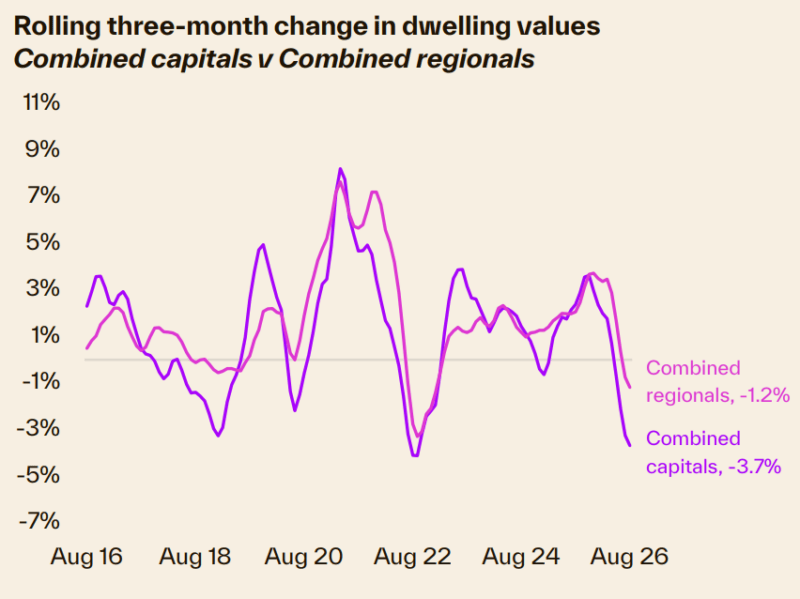
Australia’s housing market is now in its fifth straight month of decline. National home prices fell 0.9% in August, following a 1.2% drop in July, with Sydney and Melbourne, the two markets that led the boom, leading the fall too, down roughly 7% from their respective peaks.
AMP chief economist Shane Oliver, who’s calling this the sharpest downturn since the pandemic, estimates the market is only about 35% of the way through it, and expects a peak to trough fall of around 10% before conditions turn in the second half of 2027.
Meanwhile, the Reserve Bank has held its cash rate at 4.35% for two consecutive meetings; not because it is satisfied with where inflation sits, but because it is still weighing whether one more hike is needed. Annual inflation eased to 3.5% in July, down from 3.8% in June, but came in hotter than forecast, and the (Reserve Bank of Australia) RBA’s preferred underlying measure; trimmed mean inflation; is stuck at 3.6%, still well outside the 2–3% target band.
Governor Michele Bullock has been explicit that the board remains concerned about the inflation outlook, and several major banks are still pricing in a real chance of another hike before year’s end.
Put those two facts side by side and you get a genuinely unusual moment: a central bank still leaning hawkish, while the housing market is already doing some of the economic tightening for it.
Why The RBA is Not Backing Off
This is not the RBA being careless about the property market; it is a deliberate sequencing choice, and there is a real logic to it. Inflation is a lagging, backward looking number; by the time it clearly shows a slowdown, the economy has usually already cooled more than the data suggests.
Housing prices, on the other hand, are forward looking and react to rate expectations almost immediately; which is exactly why they have already started falling even though the RBA has not cut a thing.
AMP’s own read on this reflects that logic: as Oliver put it, the property slump “will weigh on economic growth but is not significant enough yet to change the direction of the RBA rate moves from up to down given the inflation problem.”
In other words, the RBA is watching the same data everyone else is; it’s just decided that a still elevated inflation rate is the more urgent problem to solve, and that a housing correction, on its own, is not yet severe enough to change that calculus.
That is a defensible position. It is also a bet; one that depends on the housing slowdown staying contained rather than spilling over into the rest of the economy before the RBA is ready to respond.
The Mechanism Worth Understanding: How Falling House Prices Become an Economic Problem
The connection between “house prices are falling” and “the broader economy could slow” is not just about people feeling poorer on paper. It runs through a specific channel economists call the wealth effect: when the value of the asset most Australian households hold the most of, their home, falls, households tend to save more and spend less, even if their income and mortgage repayments have not actually changed. Homeowners feel less financially secure, so discretionary spending is often the first thing to get pulled back.
Australia is more exposed to this channel than most developed economies, for a simple reason: housing makes up an unusually large share of household wealth here, and household debt to income ratios are among the highest in the world.
That combination means a given fall in home prices tends to translate into a larger pullback in consumer spending in Australia than the same percentage fall would in, say, the US or Germany, where wealth is spread more evenly across housing, equities, and retirement savings.
Analysts have flagged exactly this risk; that the price falls “threaten to erode household wealth and curb consumer spending just as Australia’s economy faces the risk of a sharper slowdown.” That is the tension at the heart of this story: the RBA needs demand to cool enough to bring inflation back to target, but not so much that it tips into the kind of consumption pullback that is much harder to reverse once it starts.
Is the RBA Fighting the Last War?
This is the genuinely open question, and it is worth being honest that reasonable economists land on different sides of it. The case that the RBA is looking backward: inflation data reflects decisions made months ago, while the housing market is telling you, in real time, that financial conditions are already tight enough to be biting.
By the time trimmed mean inflation clearly falls back into target, a housing driven slowdown in spending could already be well underway; and monetary policy works with long lags, so a rate cut announced in response to that slowdown would not actually help the economy for another six to twelve months.
The case for the RBA’s current approach: a 10% peak to trough correction, while painful for recent buyers, is a normal cyclical adjustment after the kind of price growth Australia saw through 2024–25, not a systemic shock. ANZ, Westpac, and CBA have all downgraded their 2026 growth forecasts in response to the slowdown, but none are forecasting recession.
And letting inflation run persistently above target to protect a housing market that had, by most measures, become overheated risks a worse outcome later; a longer, harder-fought inflation fight if the RBA blinks too early.
What It Means Beyond the Headline Rate Decision
For homeowners and prospective buyers, the practical read is straightforward: borrowing capacity has already been meaningfully reduced by this year’s earlier hikes, and the RBA’s own commentary suggests it is not planning to make credit cheaper again anytime soon, even as prices fall.
For anyone watching this as a broader signal about the health of the Australian economy, the more useful thing to track is not the cash rate decision itself; it is whether retail spending and consumer confidence data start showing the wealth effect pullback the housing numbers would predict.
If they do, it becomes a much stronger case that the RBA waited too long. If household spending holds up despite the falling prices, it is a reasonable sign that this correction really is the contained, cyclical adjustment the RBA is currently betting on.
Either way, the housing market has already made its move. The open question is simply which set of numbers, inflation or spending, forces the RBA’s hand first.
 Manners&Willis