Why South Korea and Australia Are Raising Rates While the Fed Cuts
(5 minute read)
- The Bank of Korea has delivered back to back rate hikes for the first time since 2023, lifting its benchmark rate to 3% as core inflation hits its fastest pace in over two and a half years.
- It is not alone. The Reserve Bank of Australia has spent 2026 in the same camp; three hikes, then two holds. Even as the US Federal Reserve resumes cutting.
- A year ago, nearly every major developed economy ‘s central bank was cutting rates in near lockstep. That synchrony has broken. Understanding why reveals more about the current stage of the global economy than any single rate decision does.

By Yassa Ahmed and Michael Manners
In August 2026, the Bank of Korea (BOK) did something it had not done since early 2023: it raised interest rates two meetings in a row. The second hike, in late August, lifted the benchmark rate a quarter point to 3%, following an equivalent move in July that had itself been the BOK’s first hike in three and a half years. Six of seven board members voted for it. One argued for a hold.
The reason is straightforward on paper and more interesting underneath: core inflation, which strips out volatile food and energy prices, climbed to 2.6% in July; its steepest pace since December 2023; while the economy is growing considerably faster than expected.
The BOK lifted its 2026 growth forecast to 3.3%, up sharply from 2.6% just a few months earlier, powered by a semiconductor export boom. Put simply: Korea’s economy is running hot enough that its central bank felt it had no real choice but to lean against it.
What makes this a genuinely interesting story, rather than a routine one country rate decision, is the company Korea is keeping’ and not keeping.
Australia Is in the Same Camp
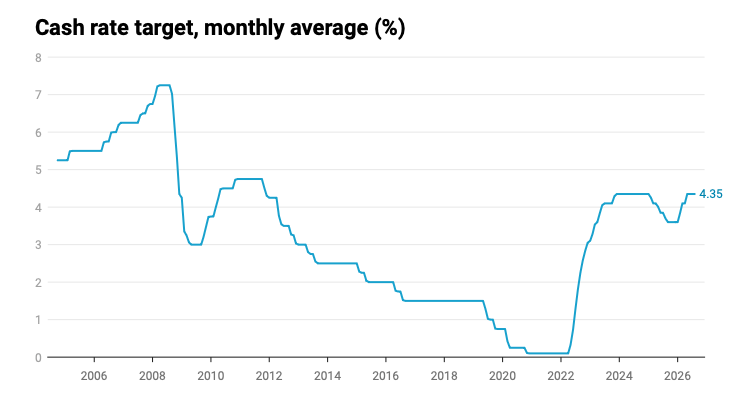
The Reserve Bank of Australia (RBA) has spent 2026 on a broadly similar path. After three rate hikes in the first half of the year, the RBA has held its cash rate at 4.35% for two consecutive meetings, most recently in August; not because inflation is solved, but because the board wants to see the earlier hikes fully work their way through the economy before deciding what comes next.
Annual inflation eased to 3.5% in July, down from 3.8% in June, but the RBA’s preferred underlying measure, trimmed mean inflation, stayed put at 3.6%; still well above the bank’s 2–3% target band.
Governor Michele Bullock has been explicit that the board “remains concerned” about the inflation outlook, and several of the big four banks are still pricing in the chance of another hike before year’s end.
That is the same basic shape as Korea’s problem: growth and inflation both running hotter than comfortable, forcing a central bank that would rather be finished tightening to keep the door open a little longer.
The Bigger Story: A Global Consensus Breaking Apart

Here is what makes this moment different from the rate cycles of the past few years. Through 2025, major central banks moved almost in unison: nine of the ten central banks overseeing the world’s most heavily traded currencies cut rates, delivering the fastest and largest wave of global easing since the financial crisis.
The Fed, the ECB, the Bank of England, the RBA, and most of their peers were all pulling in the same direction; rates coming down as post pandemic inflation finally cooled.
That consensus has come apart in 2026, and in an unusual direction: the US Federal Reserve has resumed cutting, even as several of its major economy peers, Australia, Korea, and Japan among them, have swung back toward tightening or a hawkish hold. It is a reversal of the more familiar pattern, where the US typically leads the cycle rather than diverging from it.
The drivers differ by country, but they rhyme. Japan has been raising rates to finally exit a decades long ultra loose policy stance, and a weak yen has forced a rare joint intervention with the US Treasury.
Korea’s tightening is about a currency under pressure too; the won touched a 17 year low earlier this year; layered on top of a genuine domestic growth surge. Australia’s is more purely a story of inflation proving stickier than forecast, in an economy where a resilient jobs market has kept giving the RBA less room than it would like.
Why It Matters Beyond the Rate Decision Itself

For an ordinary investor or borrower, the headline “central bank raises rates” is straightforward enough. The more useful thing to understand is what a fractured global rate cycle does beyond any one country’s mortgage holders.
When major central banks move together, currency and capital flows stay relatively stable; money is not being pulled sharply toward whichever economy currently offers the highest return. When they diverge, as they are now, that changes.
A hawkish RBA alongside a cutting Fed tends to support the Australian dollar relative to the US dollar, which cuts both ways: cheaper imports and offshore travel, but a harder road for exporters competing on price. The same dynamic is playing out more dramatically in Korea, where currency stability has become as much a factor in the BOK’s decisions as inflation itself.
It also matters for how confidently anyone should read “rates are coming down globally” as a settled trend. A year ago, that would have been a safe generalisation. Today it depends entirely on which economy you are looking at; and increasingly, on domestic pressures (a currency under strain, an unexpectedly strong export cycle, a jobs market that will not cool) that have very little to do with what any other central bank is doing.
Korea and Australia are not hiking because they want to stand apart from the rest of the developed world. They are hiking because their own inflation and growth numbers left them little alternative; and the fact that the Fed is moving the opposite way says more about the US’s specific conditions than it does about where the global cycle is actually headed.
 Manners&Willis